Estimate a kitten’s age by comparing its eyes, ears, teeth, movement, and weight, then choose the age range where those clues overlap. Closed eyes and folded ears point toward the earliest weeks; emerging baby teeth suggest roughly 2–3 weeks, while coordinated play and later tooth changes help separate older kittens. The cases below compile publicly shared observations and growth records rather than controlled studies.
Compare five clues at each stage
Alley Cat Allies’ week-by-week kitten guide supplies the early developmental examples below. ASPCApro’s guide to estimating kitten age, together with its developmental and dental charts, adds the weight benchmarks and permanent-tooth sequence.
Read each row as a transition, with overlap at its edges. The weight column identifies the specific week each example comes from, rather than setting a required range for the whole interval. The early values reproduce Alley Cat Allies’ examples; the later pound-based landmarks come from ASPCApro. Body condition affects the comparison, and weight becomes less useful for estimating age after about ten weeks.
Age range
Eyes
Ears
Teeth
Movement
Approximate weight examples
0–1 week
Closed at birth; opening may begin near the end
Folded, beginning to unfold
Toothless
Crawling, staying close to the nest
At birth: 85–110 g (2.9–3.9 oz); at 1 week: 210–240 g (7.4–8.5 oz)
1–2 weeks
Opening, generally fully open and blue by 2 weeks
Unfolding
Usually toothless; first incisor tips may appear near 2 weeks
Early, unsteady steps
At 2 weeks: 280–310 g (9.8–10.9 oz)
2–3 weeks
Open and blue
Becoming upright
Tiny incisors emerging; canines may begin near 3 weeks
Wobbly walking and early play
At 3 weeks: 365–400 g (12.8–14.1 oz)
3–4 weeks
Open and blue
Upright
Incisors and canines coming through, then visible
Walking becomes steadier; play increases
At 4 weeks: 440–470 g (15.5–16.6 oz)
4–5 weeks
Usually blue
Upright
Front teeth and canines present; premolars begin toward 5 weeks
Exploring, more coordinated play
At 5 weeks: 525–550 g (18.5–19.5 oz)
5–6 weeks
Usually blue
Upright
Premolars emerging
Running, pouncing, increasingly steady
At 6 weeks: 640–670 g (22.5–23.6 oz)
6–8 weeks
Blue may start changing around the 6–7-week transition, often near 7 weeks
Upright
Premolars coming in; 26 baby teeth by about 8 weeks
Agile play, running, jumping
At 7 weeks: 770–800 g (27.1–28.2 oz); at 8: 920–950 g (32.4–33.5 oz)
8–12 weeks
Adult color emerging or established; some cats retain blue eyes
Upright
Baby teeth present; first permanent middle incisors may appear near 12 weeks
Confident exploration and play
ASPCApro landmarks: 8 weeks about 907 g (32 oz); 10 weeks 1,134 g (40 oz); 12 weeks about 1,361 g (48 oz)
12 weeks and older
Mature color increasingly established
Upright
Permanent middle incisors around 12 weeks; next pairs around 14 and 16
Coordination increasingly adult-like
At 12 weeks: about 1,361 g (48 oz); subsequent weights vary widely
Start with eyes and ears
Look in ordinary daylight and write down two observations: eyes closed, partly open, or fully open; ears folded, unfolding, or upright. ASPCApro places eye opening around 8–12 days, with eyes generally fully open by two weeks. Alley Cat Allies includes kittens whose eyes begin opening near one week, which is why the table leaves room around that transition.
Eye color becomes useful later. Across the sixth and seventh weeks, look for the first move away from newborn blue; Alley Cat Allies lists blue eyes at six weeks and possible color change at seven. A cat that keeps blue eyes into adulthood needs the other clues instead. The difference between eye opening and eye-color change matters when comparing an early kitten with an older one; see when kittens open their eyes for that first milestone.
Amber eyes change the starting row. A caregiver photographed a found tabby with fully upright ears, amber-colored irises, and a slim juvenile body. Those visible clues make roughly seven weeks or older a useful working estimate, shifting the comparison toward the 6–8-week and later rows; add a dated weight and a note about the front teeth before narrowing it further.
Use teeth to narrow the comparison
Start with the little front teeth, called incisors, then the pointed canines beside them. Alley Cat Allies shows first incisor tips around two weeks and incisors and canines emerging around three weeks. By four weeks, those front teeth and canines are present; premolars farther back begin appearing around five to six weeks.
For an older kitten, look for a change in tooth shape. Baby incisors are narrow and pointed; permanent incisors are broader with flatter edges. ASPCApro puts the first permanent middle pair around 12 weeks, followed by the next pairs around 14 and 16 weeks. An easy glimpse during ordinary handling is enough to make a note; let the kitten relax with its mouth closed between observations.
Pointed teeth move the estimate forward. Another caregiver photographed a found kitten’s tiny front teeth and two pointed upper canines. These fit the baby-tooth stages beginning around 3–4 weeks, so compare the 3–4, 4–5, and 5–6-week rows first, then check whether premolars are appearing farther back; record that next tooth observation beside the kitten’s weight.
Watch an ordinary walk or play session
On a safe floor, watch the kitten move toward something it already wants, such as a familiar toy. Note crawling, wobbly steps, steady walking, or running and pouncing. A short video is useful because it preserves several steps and a turn, rather than just a standing pose.
ASPCApro places walking around three weeks; a kitten walking well and playing is generally at least four weeks old. Alley Cat Allies describes good running at six weeks and confident exploration and jumping around eight. Use those actions with teeth and eye development: steady walking plus emerging premolars points to a different part of the table from crawling with closed eyes.
Add a dated weight in grams and ounces
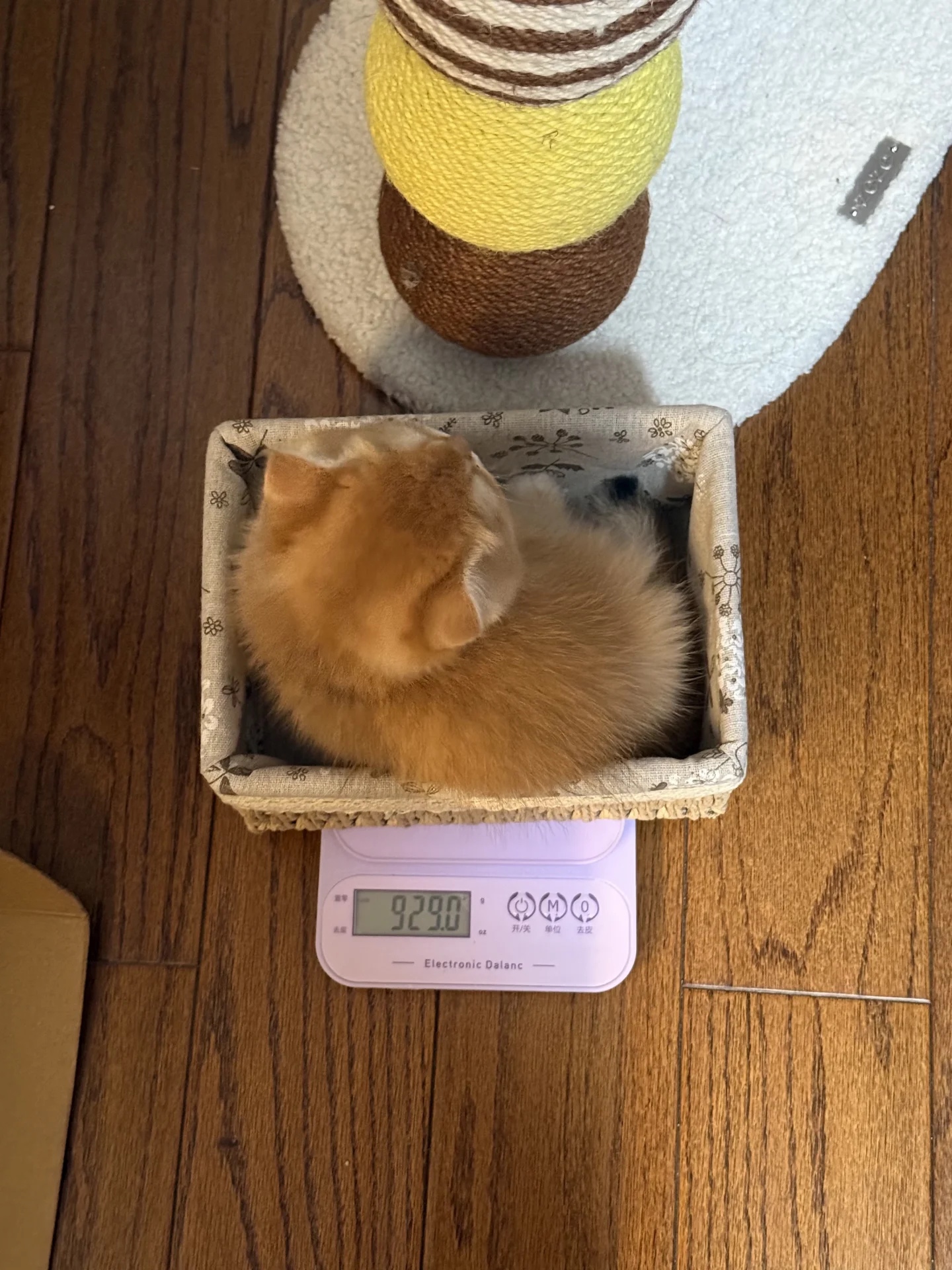
Place a shallow, stable weighing tray on a digital scale, zero it, then gently add the kitten. Record the date and grams, using the same setup for the next measurement. To convert grams to ounces, divide by 28.35; 1 pound equals 16 ounces, or about 454 grams.
ASPCApro’s quick reference for kittens in good body condition is about 1 pound at four weeks, 2 pounds at eight weeks, and 2.5 pounds at ten weeks. Think of those as landmarks to compare with the developmental signs. A known-birthday growth log makes the size of the approximation easier to see.
Weight alone suggested a younger kitten. A caregiver recorded a kitten born on December 17: on February 16, at about 8.7 weeks, it weighed 850 g (30.0 oz), and on February 19, at about 9.1 weeks, 929 g (32.8 oz). Interpolating between ASPCApro’s eight-week 907 g and ten-week 1,134 g landmarks gives about 988 g and 1,037 g at those actual ages—roughly 138 g and 108 g above the recorded weights, or around 100 g lighter than the age-based shorthand. Weight alone would suggest about eight weeks; compare a dated weight with teeth and movement before choosing the age range.
The four-week landmark is about 454 g (16 oz). Halfway between the eight- and ten-week landmarks, the calculated nine-week value is about 1,021 g (36 oz), or roughly 1,000 g; this straight-line comparison is a way to illustrate the shorthand, not a growth target. The kitten’s actual age comes from its birth date, while its lower recorded weights show why the same pounds-to-weeks shortcut can make a kitten appear younger. For the longer timeline, see when cats stop growing.
Emerging teeth matched an early weight range. During a four-day weighing series, another caregiver noted tiny baby teeth beginning to poke through; one photograph shows 277.7 g (9.8 oz). That combination sits near the 2–3-week comparison stage: about 280 g near two weeks, with tooth emergence spanning the transition toward three; write the tooth milestone next to that day’s weight before choosing a narrower range.
Choose the range where the clues overlap
Make one dated line with all five observations. For example, “blue eyes, upright ears, incisors and canines visible, steady walking and play, 450 g (15.9 oz)” fits the overlap around 3–4 weeks better than weight alone. Compare the neighboring row as well, especially when a tooth is just appearing or walking is still unsteady.
If the clues point to different intervals, or an age-dependent care decision is coming up, ask a veterinarian to confirm the working range. Bring the weight log, tooth notes, and walking video together. Once the kitten is settled, introductions to resident cats are a separate gradual process.
FAQ
How can you tell how old a kitten is?
Compare eyes, ears, teeth, movement, and weight with the same rows of the age table. Choose the interval supported by several observations and date the notes so you can compare later changes.
How old is my kitten if I do not know its birthday?
Start with a range: emerging baby teeth and a weight near 280 g (9.9 oz), for example, suggest comparing the 2–3-week stage. Add eye, ear, and movement observations to refine it.
How do you determine kitten age from weight?
For a kitten in good body condition, compare roughly 454 g (16 oz) at four weeks and 907 g (32 oz) at eight weeks. Check those landmarks against the teeth and movement, then follow the dated measurements over time.
How can you tell how old a stray kitten is?
Use the same five clues even when there is no birth record: photograph the eyes and ears, note visible teeth, watch ordinary movement, and record a dated weight. Compare neighboring rows of the table and keep a range where the signs overlap. Weight alone can suggest a younger age, as the known-birthday example shows.